
Agents Don't Replace You. You Still Decide — They Just Free Your Time.
The MCP roadmap just added agent identity and delegated task primitives. That's the infrastructure this argument needed.
Scope & limitations — read first
AI agent adoption · agent identity · enterprise API readiness · human-in-the-loop design
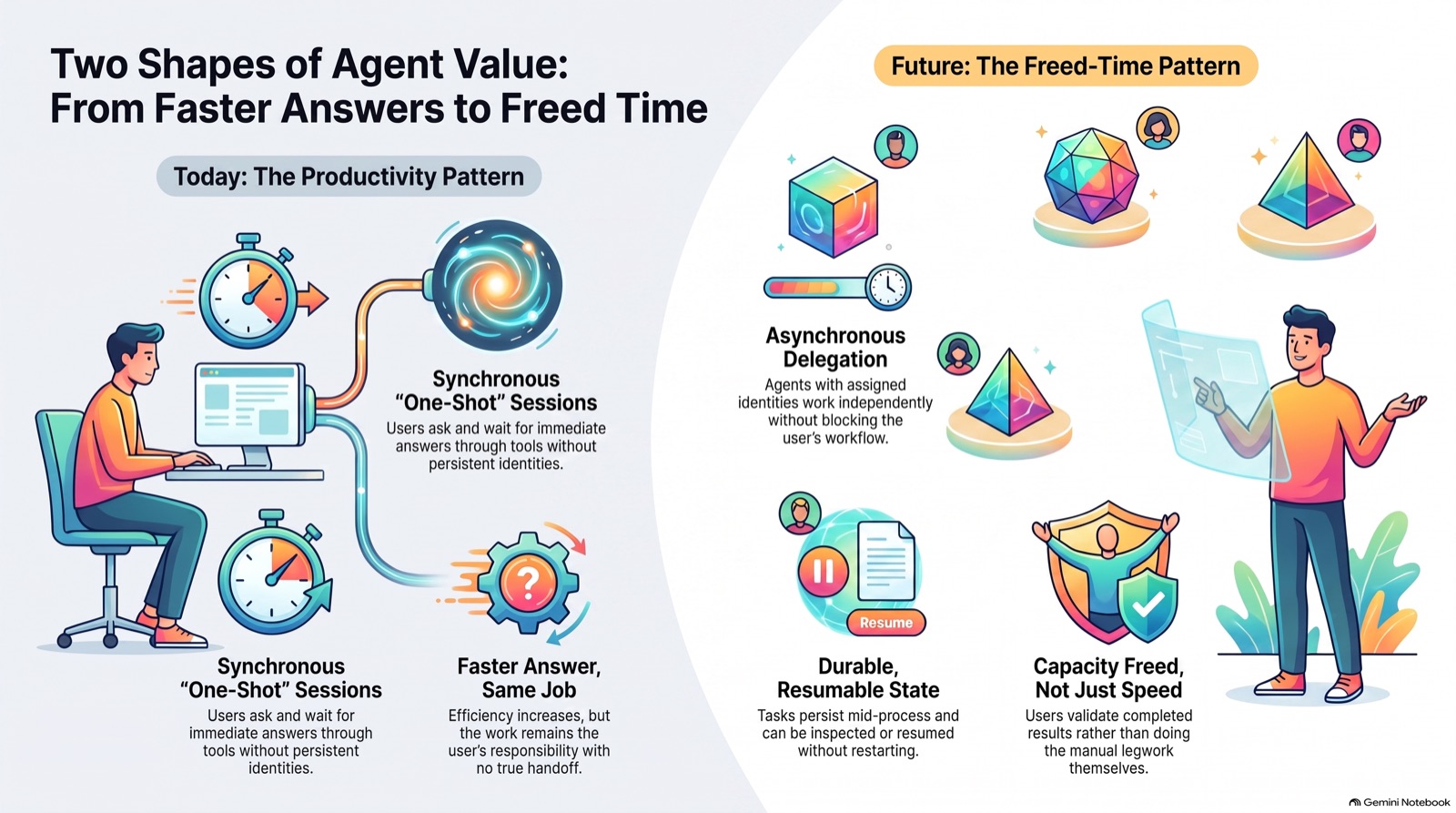
Every agent pitch I see leads with speed. Faster than a human, faster than the old workflow, 10x throughput. It's the wrong axis to sell on, and it's setting up the wrong expectation for what these systems are actually good for.
An agent isn't valuable because it does a five-minute task in thirty seconds. It's valuable because it can absorb the task that takes two hours of tedious cross-referencing — the one a human keeps pushing to tomorrow, or does at 80% quality because there's no time to do it properly. That's a different kind of value than speed. It's capacity.
To be clear about what "you still decide" means here: it's not that a human approves every click an agent makes — that would defeat the point of delegation. It's that the human sets the boundaries the agent operates inside, and owns and validates what comes out. The agent acts; the person is still accountable for the outcome.
This is an assistant, not a replacement
We've done this shift before. Moving from paper to computers didn't replace the clerk — it changed what a day of clerking looked like, and let one person handle what used to take three. Natural language as an interface to computation is the next version of that same move. The agent doesn't replace the person who owns the outcome. It changes what their day looks like.
That distinction matters because it sets who's accountable. A replacement doesn't need a human checking its work. An assistant does — at least at first, and always for the cases that matter.
Enterprises Are Building Half the Foundation
Every enterprise AI conversation right now is about data readiness — is it clean, is it labeled, is it in a vector store the model can retrieve from. Almost none of them are asking the other question: can an agent actually act through our systems safely?
That's an API problem, not a data problem. Most internal APIs were built for other software to call, with intent baked into the calling code, not for something that has to infer intent from a natural-language instruction and then decide which endpoint, with which parameters, under which constraints. An agent that understands your data perfectly but can only act through raw CRUD endpoints isn't an assistant — it's a smarter search bar with no hands.
Identity is the precondition, not a feature
You can't assign an agent to a user. You can't have that user meaningfully validate the agent's output, or trace a bad outcome back to a decision, without the agent having its own identity — not a shared service account, not a blanket API key stapled to a workflow.
This is exactly the gap the Model Context Protocol's maintainers named in the roadmap they published on August 22, 2026: agent identity, delegated permissions, progressive tool discovery, and primitives for long-running, asynchronous work. Read in sequence, those four priorities describe a protocol growing up from "call a tool, get a result" into infrastructure for agents that are assigned to someone, act over time, and hand off partial results for a human to check. Most of this is still in motion, not shipped — some pieces landed in the July 2026 spec release, others remain extensions or open proposals, so it's a direction the protocol is committing to rather than a finished capability.
Reference
Model Context Protocol Blog — The New MCP Roadmap. Published Aug 22, 2026 by lead maintainers David Soria Parra and Den Delimarsky, naming agent identity and delegated/long-running task primitives as core priorities — the infrastructure a real assign-agent-to-user model depends on.
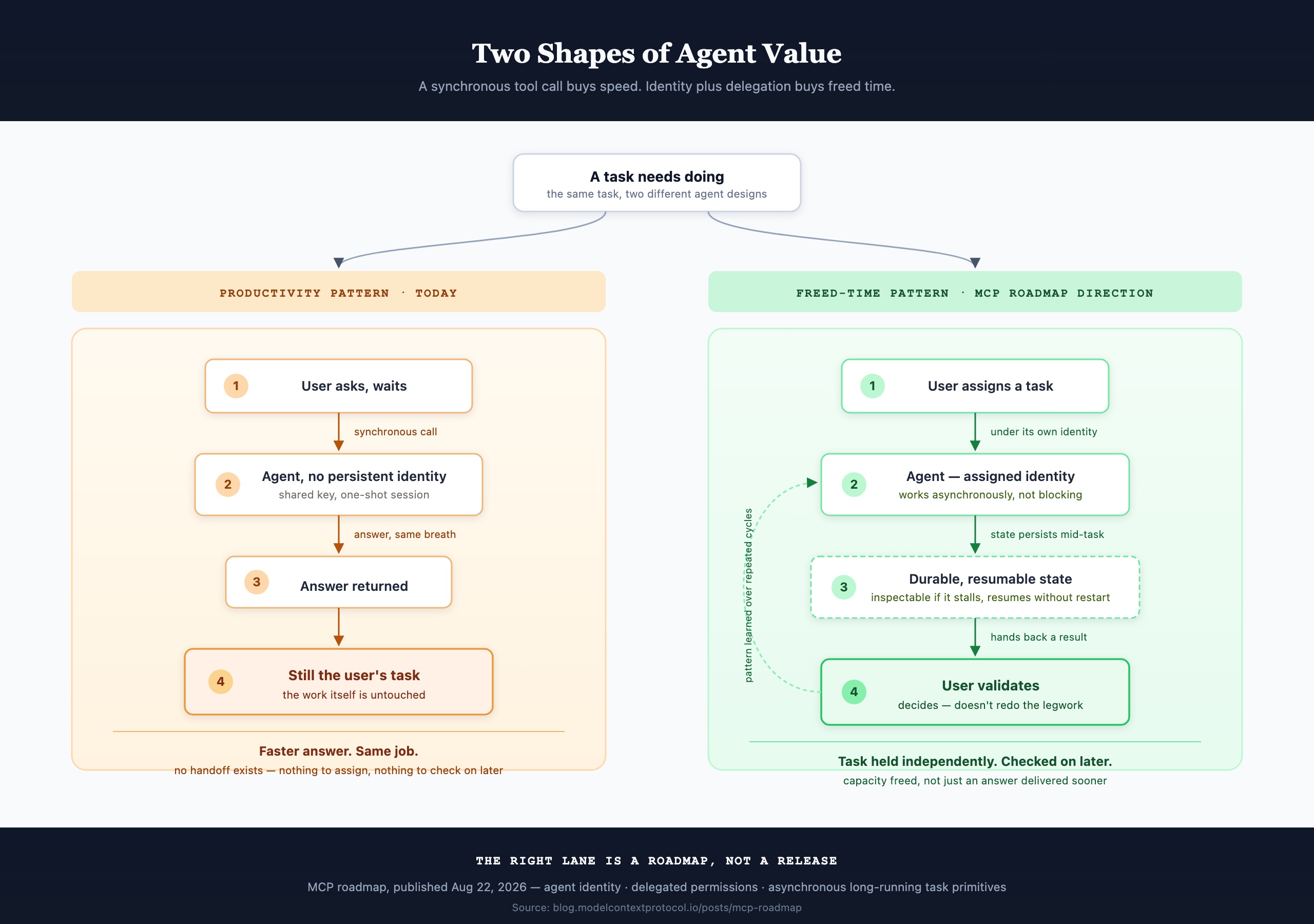
Without that identity layer, "the agent did it" is an unanswerable sentence. With it, an agent's actions are attributable to a specific assignment, a specific user relationship, a specific scope — the same accountability structure you'd expect from a junior hire, not a script.
What happens when the agent stalls
None of this matters if the agent quietly hangs and the task disappears into a void. A junior hire who goes silent mid-task is a problem you can walk over and check on. An agent needs the same recoverability.
This is what MCP's Tasks primitive is built for: a "call-now, fetch-later" pattern where a request returns a durable task handle immediately, and the real work continues in the background with a status a client can check — working, waiting on input, completed, failed, or cancelled. That durable status is what lets a user pick a stalled task back up instead of losing it. But the roadmap is candid that this is unfinished work: production use has already exposed gaps in retry behavior — who decides to retry a failed task, and under what backoff — and in how long results stick around before they expire. Until those gaps close, "long-running" can still mean "long enough to fail somewhere you can't see."
The trust curve is earned, not assumed
The honest version of this story doesn't start with time saved. It starts with time spent. The first weeks with an agent assigned to a real task, a user is validating almost everything it produces — and by the time you account for that review, it may not be saving any effort at all.
- What changes over that period isn't the agent getting smarter — it's the user learning where the agent is reliable and where it isn't
- It's pattern recognition on the human side: this class of case, the agent nails every time; this other class, it needs a second look
- Validation stops being uniform and becomes targeted — light-touch on the familiar, careful on the unfamiliar
- The net effect shows up weeks in, not on day one: human attention concentrates on the genuinely hard cases, the agent absorbs the long tail of routine ones
The payoff isn't that the agent got faster. It's that the human stopped spending judgment on the cases that didn't need it.
What to build now, before the roadmap ships
None of this requires waiting for MCP's identity and delegation work to land. Three things are buildable today, and they're the actual prerequisites — not the model, not the roadmap.
- Audit your APIs for intent, not just access — can an operation be called with a natural-language-derived plan, or does it only make sense inside code that already knows the sequence?
- Give every agent a distinct, traceable identity now, even a crude one — a scoped service account per agent role beats one shared key, and it's the on-ramp to real delegation later
- Design the validation checkpoint before the agent, not after — decide up front which outputs need a human look and which don't, instead of discovering it in production
- Log every agent action against who assigned it and why — the accountability trail the roadmap formalizes is buildable by convention today, just not enforced by the protocol yet
The roadmap is the protocol catching up to a pattern teams can start building by hand right now. Waiting for the spec to ship before starting is waiting to be behind it.
Not replacing. Enabling.
None of this is the jobs-replacement story the industry keeps telling. It's the same story as every prior interface shift: paper to computers, command line to GUI, keyboard shortcuts to natural language. Each one didn't remove the person — it changed what the person spent their attention on, and let more get done with the same judgment.
Agents assigned to people, backed by real identity, acting through APIs actually built for them, validated by humans who get faster at knowing when to trust them — that's not a faster version of the current workflow. It's a different allocation of human time, toward the parts of the job that were always the hard parts.
Comments